
I have spent much of my life moving between environments that demand composure under pressure.
Today, my work sits across founder-led, founder transition and investor backed consumer businesses in luxury, beauty, fashion, lifestyle and tech. It is shaped by lived global operating experience across Europe, the Middle East, the Americas and Asia-Pacific, from founder-stage businesses through to global organisations. Alongside that work, aviation has remained a parallel discipline for many years, including obtaining my flying instructor qualification.
At first glance, those worlds appear unrelated.
One centred around organisations, people and decision making. The other around aircraft, systems and procedure.
In practice, they are surprisingly similar.
Both reward calm. Both punish ego. Both expose the difference between confidence and competence very quickly.
People often ask me about flying after seeing fragments of it on my Instagram.
Cockpits.
Weather systems.
Small aircraft on remote airfields.
The occasional image from inside a cockpit at sunrise, or above cloud somewhere over Europe.
Usually the question is some version of: "How does flying fit into your life when your career has largely been spent in consumer businesses?"
The answer is simple.
Flying has shaped how I think.
Long before I sat on boards or led international teams, aviation taught me about responsibility, preparation, judgement, humility and calm under pressure. Over time I realised many of the principles that create safety and performance in the cockpit translate remarkably well into leadership, transformation and decision making inside organisations.
What aviation also teaches you very quickly is the true consequence of poor judgement.
In business, when you make mistakes, as every leader eventually does, the consequences are usually commercial:
- lost time
- lost money
- lost momentum
- damaged morale
- strategic drift
Serious, certainly.
But rarely catastrophic in the most literal human sense.
In the cockpit, the equation is very different.
Poor preparation. Weak discipline. Emotional decision making. Or loss of situational awareness. All can have immediate physical consequences. The margin for error is often brutally unforgiving.
That reality changes you.
It teaches humility very quickly.
It also teaches you the importance of procedure, clarity and calm under pressure because aviation does not reward ego, theatre or overconfidence for very long.
Four years ago, in the early weeks after the invasion of Ukraine began, the scale of displacement and humanitarian disruption was accelerating rapidly. Hospitals and aid organisations were struggling to access critical equipment quickly enough through normal logistics channels. The supplies already existed in the UK: trauma kits, defibrillators, electronic syringes, tourniquets, gowns and other life saving equipment. But the infrastructure and speed required to move them where they needed to be was still catching up to the reality on the ground.
So pilots started volunteering.
Small aircraft.
Not military transport.
Not corporate operations.
Just people trying to help however they could.
Around that time I received a call from Charlie Kimbell at CK Aviation, part of the Cirrus aviation community, asking whether I would be willing to fly one of the missions transporting medical supplies towards the Ukraine / Poland border.
The answer was immediate.
Yes.
Partly because the humanitarian need was obvious.
Partly because aviation communities often operate with a quiet sense of responsibility toward one another.
But also because moments like that clarify what responsibility actually means.
If you have skills, mobility, experience or resources that can genuinely help people during difficult moments, there are times in life where stepping forward matters.
Not because you are fearless.
Not because you are extraordinary.
But because responsibility is ultimately carried by ordinary people deciding to contribute where they can.
The reality of the mission also carried a certain psychological weight from the beginning. We were not flying into combat, of course, but we were flying towards the edge of a war unfolding in real time. Airports, borders and infrastructure across the region were already under pressure and nobody fully understood how conditions might evolve over the following days.
I knew it would be an operationally demanding trip.
I also knew it would carry a different kind of emotional weight.
Earlier in my career I had worked alongside Peter Hamelinck at Scotch & Soda based in Amsterdam. Years later he moved from creative leadership into photography, focusing on portraiture, reportage and outdoor work. We stayed in touch over the years and I asked him to join me on the mission.
Partly because I thought he would enjoy the experience.
Partly because I knew he would see things other people might miss.
And partly because I knew he would be somebody I could still laugh and joke with during what we already knew would be a challenging trip.
What I have always respected about Peter's photography is the humanity in it. His images do not force emotion or turn people into spectacle. His images notice things quietly:
- fatigue
- atmosphere
- tension
- stillness
- people
I wanted somebody alongside me who would document the experience with sensitivity rather than simply record events.
Flying has been a constant throughout my life alongside my career. I hold various national pilot licences and flying instructor qualifications and fly single, twin and turbine engine aircraft. I also flew helicopters for a period, although I eventually gave them up. That is another story.
Aviation has shaped me profoundly.
It taught me:
- discipline
- preparation
- accountability
- calm under pressure
- respect for procedure
- the importance of sequence
And this mission demanded all of it.
I remember standing at Southend Airport before departure looking at the sheer volume of medical equipment spread across the hangar floor waiting to be loaded. Aircraft seats had been removed to maximise capacity. Every available space was packed tightly with supplies.
The atmosphere was unusually focused.
Not dramatic.
Not performative.
Just purposeful.
People moved quickly and quietly around the aircraft:
- checking manifests
- loading boxes
- calculating weight
- confirming routes
- reviewing weather
Nobody needed long explanations about what was required.
The weather that morning was already poor and deteriorating across large parts of Europe.
Low cloud.
Heavy rain systems.
Embedded thunderstorms.
Forecast icing further east.
Visibility tightening progressively across the route.
And psychologically there is another layer you carry quietly in the background: you know you are flying towards the edge of a war zone.
Not directly into combat, of course, but towards the edge of a humanitarian crisis unfolding in real time.
The emotional texture of the flight felt completely different from normal general aviation.
The cargo behind us was not commercial.
It was not discretionary.
It was equipment intended to keep people alive.
The flight into Lublin became increasingly demanding as the weather deteriorated further east.
I spent long periods navigating around thunderstorms while constantly reassessing conditions ahead.
The workload in flying often builds slowly rather than dramatically:
- fuel
- routing
- icing exposure
- weather avoidance
- alternates
- timing
- fatigue
Small decisions accumulating continuously over hours.
By the time we began the approach into Lublin the cloud base had reduced significantly.
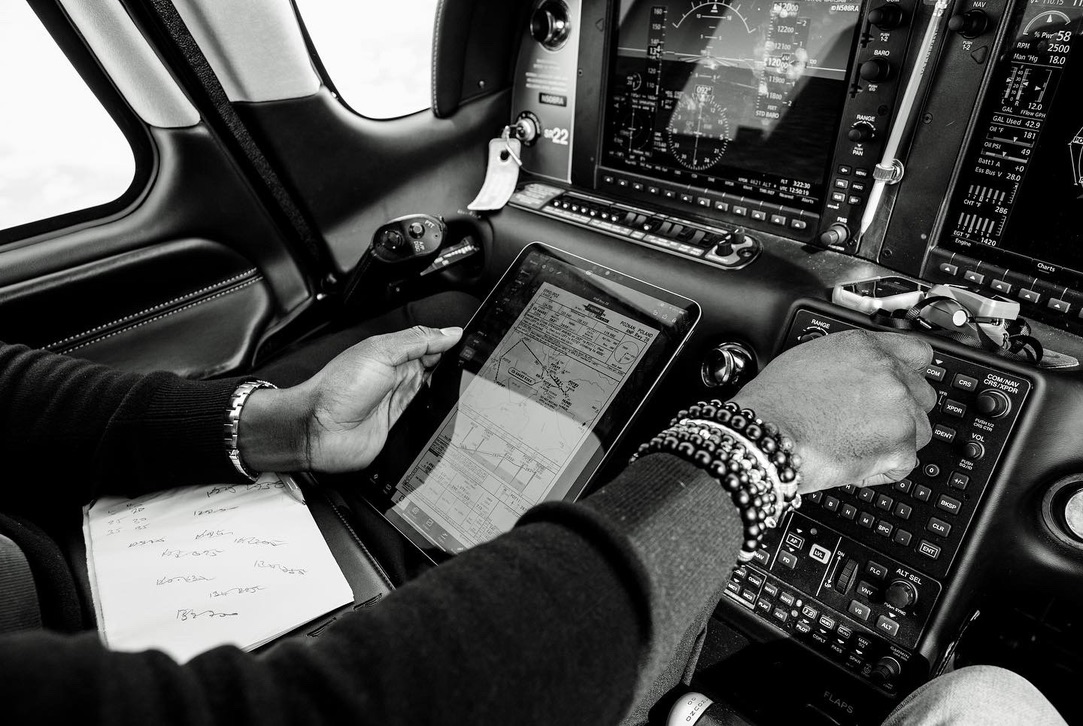
We flew the ILS [Instrument Landing System: A radio-based system that enables pilots to guide the airplane down to the runway safely, even in zero visibility like heavy fog or pitch-black at night] approach down to minimums.
Then finally, after hours of weather, rerouting and tension, we broke through the cloud and saw the runway lights beneath us.
I still remember the feeling inside the cockpit when the runway appeared.
Not celebration.
Just concentrated relief.
The kind that comes after long periods of sustained focus.
We unloaded the aircraft the next morning. Medical teams and volunteers moved quickly and efficiently. Everyone understood the urgency. Everyone understood the assignment.
Peter spent much of the time photographing quietly:
- faces
- hands
- movement
- fatigue
The human details.
After some rest we departed for the flight home.
The weather remained unstable although initially the sector felt more manageable than the inbound flight. We were established in cruise at around 10,000 feet when a cockpit warning light illuminated indicating low oil pressure.
In a piston aircraft engine, oil pressure is critical. The oil system lubricates and cools fast moving internal engine components operating under enormous heat and stress. If oil pressure drops significantly or is lost completely, those components will begin overheating and failing very quickly.
It is one of those warnings pilots are trained never to normalise.
What struck me most was how quickly the atmosphere in the cockpit changed.
Not emotionally.
Procedurally.
Training narrows your thinking in moments like that.
The cockpit became calm:
- engine instruments
- temperatures
- pressure indications
- nearest alternates
- weather
- routing
- contingency planning
Nothing rushed.
Nothing dramatic.
Just disciplined sequence.
In aviation there is a phrase repeated constantly during training:
Aviate. Navigate. Communicate.
Fly the aircraft first.
Understand where you are second.
Communicate third.
The order matters.
And over time I realised how deeply that experience shaped the way I later approached pressure and leadership in business.
Because pressure compresses thinking.
People either become chaotic or overly narrow.
Communication accelerates before understanding does.
Activity increases before priorities become clear.
But the strongest environments I have experienced, in aviation, sport and business, usually feel surprisingly calm internally during difficult moments.
Not because people are relaxed.
Because sequence creates clarity.
The best leaders I have worked with understand how to restore order:
- what matters now
- what matters later
- what can wait
- what cannot
- who is responsible
That mission also reinforced something more personal for me.
Two values that increasingly sit at the centre of how I try to live and lead: humanity and courage.
Humanity because leadership ultimately begins with people.
And courage because courage is rarely loud.
Often it is simply the willingness to move towards uncertainty while remaining calm enough to think clearly and act responsibly.
That trip reminded me that capability carries obligation.
If you have skills, mobility, experience or resources that can genuinely help people during difficult moments, there are times in life where stepping forward matters.
Not because you are fearless.
Not because you are extraordinary.
But because humanity depends on ordinary people being willing to carry responsibility when circumstances become uncomfortable.
Peter still has the photographs from that journey. His photography work extends far beyond that trip and can be viewed at peterhamelinck.photography
What stays with me most when I look at them now is not the aircraft or even the mission itself.
It is the seriousness in people's faces.
The quiet understanding that however small our contribution was in the context of a war, it mattered deeply to somebody waiting on the other side of the supply chain.
That perspective stays with you.
Calm is procedural.